

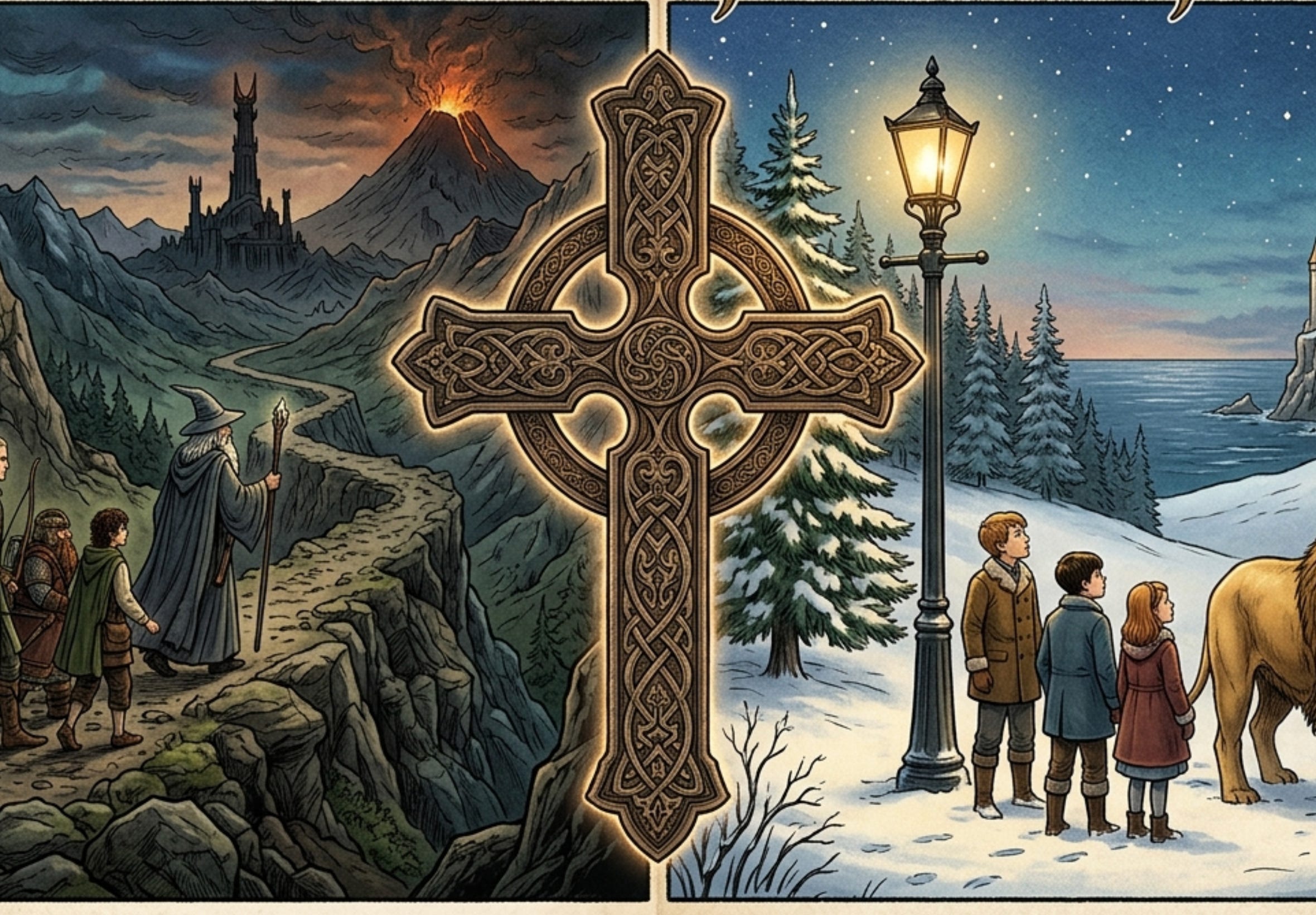
When you think of childhood fantasy, two names you would likely ponder are J.R.R. Tolkien and C.S. Lewis. Not only did these men change the landscape of fantasy writing, but they were also close friends.
They weren’t just colleagues at Oxford; they were the heart of the Inklings, a small circle of writers who met in smoke-filled pubs like the Eagle and Child to read their unfinished manuscripts aloud. Their bond wasn’t just about sharing a pint. In many ways, we wouldn’t have The Chronicles of Narnia or The Lord of the Rings without their mutual badgering. Lewis was Tolkien’s biggest cheerleader, constantly pushing him to actually finish his “hobbity” stories when Tolkien was tempted to keep tinkering with Elvish grammar forever.
On the flip side, Tolkien played a massive role in Lewis’s spiritual life. After a long, famous nighttime walk at Magdalen College, Tolkien, along with their friend Hugo Dyson, helped convince the then-atheist Lewis that Christianity was the true myth: a story that actually happened.
Even though they were both Christians, they had a famous creative spat over how to put religion into fiction. The result of this tension is seen in both of their writing styles.
Lord of the Rings
Tolkien was firm that he hated obvious allegory; he didn’t want his stories to be a one-to-one map of the Bible. Instead, he wanted his faith to be like the soil the tree grows in. It is what feeds the whole thing from underneath, showing up in themes like mercy and providence, but never actually breaking the fourth wall to preach at you.
This is why he would get frustrated when people tried to say Gandalf was basically Jesus; for Tolkien, that was missing the point. He wasn’t trying to rewrite the Gospels in Middle-earth. Even though he was a devout Catholic, he wasn’t interested in making a ‘religious’ book in the traditional sense. His real goal was much bigger: he wanted to create a massive, epic mythology for England, something to help process the sense of loss and the question of what comes next, questions that hung over everyone after the devastation of the Great War.
The Chronicles of Narnia
Lewis was much more direct than Tolkien with his faith. While Tolkien wanted his religion to stay hidden in the bones of the story, Lewis opted for a more immediate approach, asking the question, “If Christ actually showed up in a world full of talking animals and magic, what would he look like?”
That is how we got Aslan. For Lewis, Aslan wasn’t just a symbol or a metaphorical hero; he was meant to be God, plain and simple, stepping into Narnia to show how the divine might act in a completely different universe. He didn’t mind if the connection was obvious because he wanted the reader to feel the weight of that religious presence right there on the page.
Creative Bickering
Believe it or not, Tolkien actually rather hated The Lion, the Witch and the Wardrobe when Lewis first read it to him. He thought it was a sloppy mishmash of mythologies. To Tolkien’s rigorous mind, you couldn’t just have Father Christmas, a Greek faun, and a talking beaver all in the same world; it broke the inner consistency he valued so much.
Lewis, ever the enthusiast, didn’t care. He wanted to capture the feeling of the numinous, even if the logic was a bit messy. Despite their creative bickering and the fact that they drifted apart slightly in their later years, their impact is inseparable.
Tolkien gave us the depth of a world that feels like it has a soul, while Lewis gave us the wonder of stepping through a wardrobe into a moral universe. They proved that fantasy wasn’t just for kids; it was a way to explore the biggest questions of human existence. They also both entertained generations with their wonderful tales of heroes and adventure.
Which is your favourite?
Until next Friday: Read to learn. Read to escape. Read to smile.