

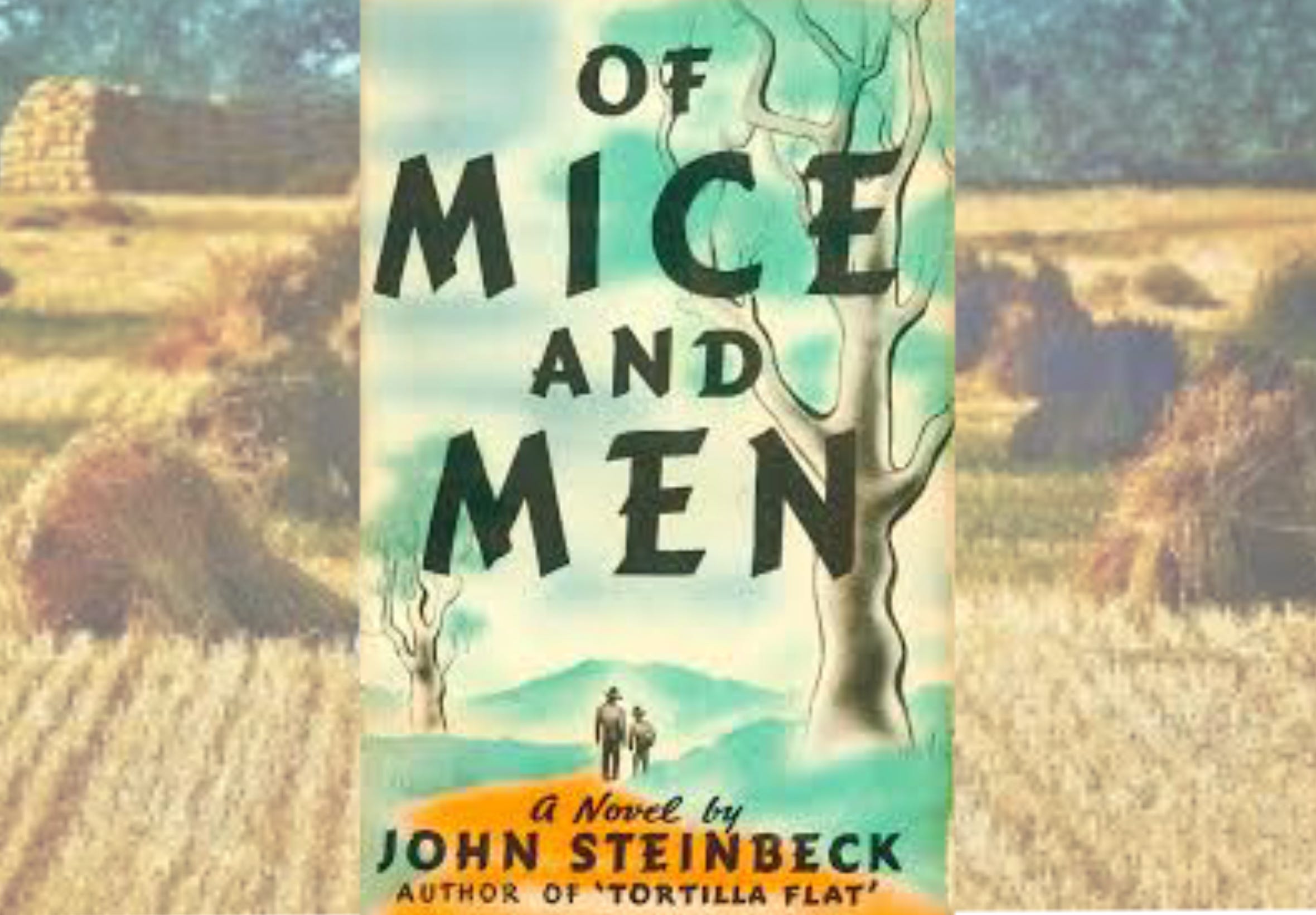
This was a re-read for me, having read Of Mice and Men at school several years ago. It is a book I have been excited to revisit ever since I started my Steinbeck journey.
It is structured in a simple way; there are six sections or chapters, and each occurs in a specific location, much like scenes in a play or film. Most of the story is told through dialogue and action with very little internal monologue, mirroring a script. This, however, does not make it any less powerful.
Section 1: The Clearing by the River
The opening of this book is beautiful. While the descriptive language is typical of Steinbeck, it still took my breath away. Within a couple of sentences, I was sitting on the bank with those characters. I know I did not appreciate the language when I read it as a teenager.
The relationship between George and Lennie is so complex. At its heart is friendship, but there are times it wavers on the abusive. However, this can go both ways; although George is verging on being abusive to Lennie, Lennie is also manipulating George. It is an interesting dynamic.
The hints about what happened in Weed and why the pair had to flee set the scene well for what is about to happen, without giving too much away. Another hint is the mouse that Lennie keeps in his pocket and the description of how he has killed mice in the past by simply loving them too roughly.
This section also introduces the concept of the ‘American Dream,’ the idea of owning a small farm. To Lennie, this is all about the companionship of rabbits, but to George, it is more psychological; he longs to escape the life of the migrant worker.
Section 2: The Bunkhouse
Steinbeck, in all his novels, tries to portray certain characters as being on a higher intellectual or moral level. Think of Sam Hamilton in East of Eden. Then there is Crooks in Of Mice and Men. We later find out that Crooks reads because, as a Black man, books are his only company.
There are moments when some of the language used for Crooks is outdated, but it is important to recognise that society and language evolve; that should not detract from the writing itself.
In this section, we meet many who work on the ranch. There is Candy, the older rancher who has been injured and is kept on for that reason and little else. We meet Curley, who clearly has what we would consider ‘little man syndrome’; he is aggressive and insecure about his position in life. We also meet Curley’s wife, who is portrayed as a temptress and a dangerous woman.
The development of Lennie’s love of animals is further shown here. We see how the big man loves those smaller than him, though not always with positive consequences.
The transition from the river to the bunkhouse marks a move from nature and freedom to civilisation and confinement. George’s immediate wariness of Curley and his wife sets a tone of impending doom.
Section 3: The Breaking Point
It bemused me the last time I read this how strange all the other men found the fact that George and Lennie travel together, and that was no different on this re-read.
When George tells the story of what happened in Weed, I wonder if he is telling the truth or downplaying the incident. Was it more severe than what the reader is led to believe?
Then there is the symbolism of the old dog being shot. This makes Candy reflect on his own vitality; he is old and wonders what will happen to him when he is no longer useful. Will someone try to shoot him, or metaphorically do away with him?
In the brutal world of the Great Depression, if you can’t work, you have no value. Carlson’s insistence on shooting the dog because it “stinks” and is “no good to himself” mirrors how the world views Candy (who is missing a hand) and Lennie (who is intellectually disabled).
This is also the section where we see Lennie’s sheer brute strength. While Lennie wins the physical fight with Curley, the event ensures that Curley will eventually seek a more permanent revenge.
Section 4: Crooks’ Room
This is a deeply philosophical chapter. We see the intersection of race (Crooks), disability (Lennie), and age (Candy).
We explore the fate of Black men in this chapter and how they lost their dignity and self-worth. Crooks resists bettering himself even though he thinks he can, which puts him on a similar status to Lennie.
In a shocking moment, Curley’s wife threatens Crooks with lynching. Steinbeck shows that even the oppressed will “pick on” those even lower than them to feel a momentary sense of power.
Section 5: The Death in the Barn
The way Steinbeck sets the atmosphere for this scene, using the noises of the animals like background music in a film, is masterful.
The sequence moves from Lennie killing his puppy to Lennie killing Curley’s wife. It highlights that Lennie is not ‘evil,’ but rather a force of nature that cannot exist within the fragile structures of human society.
Would Lennie have done what he did if he weren’t so scared of George’s reaction? In my opinion, George is partially responsible for the killing. What do you think?
When Candy finds the body, his first thought isn’t for the woman, but for the farm. He realises that with this act, the dream is dead. George’s realisation is even more profound: he must now become the “lonely man” he always claimed he didn’t want to be.
Section 6: Return to the River
The end of the book goes full circle, returning us to the same location where we started. The mood has shifted from a hopeful evening to a sombre, final sunset. The “water snake” that was safely swimming in Chapter 1 is eaten by a heron in Chapter 6; the cycle of predators and prey is complete.
Lennie’s trust at the end is heartbreaking. George feels he must kill Lennie himself. It is his responsibility because Candy did not kill his own dog and felt bad about it afterwards. He uses Carlson’s gun, the same gun used on the dog, and for the same reason: to provide a “merciful” end to a creature that can no longer survive in its environment.
George recites the dream one last time, using it as a “lullaby” to keep Lennie happy as he kills him. This is George’s ultimate act of love, sparing Lennie from the “lynch mob” violence of Curley.
The ending makes us further question humanity when both Curley and Carlson are confused as to why George is so upset. The world of the ranch hands is so devoid of empathy that they cannot even comprehend the depth of George’s grief.
Throughout the story
Lennie loves the mice because they are soft, but he kills them because he is too strong and ‘simple’ to handle them delicately. This is the ultimate metaphor for Lennie himself: a gentle soul trapped in a powerful, dangerous body. Just as the mice are accidentally crushed by Lennie, Lennie is eventually crushed by a society that doesn’t know how to handle his ‘difference.’
The rabbits are Lennie’s primary obsession and the central image of ‘The Farm.’ They represent hope, autonomy, and the Edenic promise of the American Dream. Unlike the mice or the dog, the rabbits never actually appear in the physical world of the ranch; they exist only in Lennie’s mind and George’s stories. This highlights the illusory nature of their dream.
In the final chapter, a giant rabbit appears to Lennie and scolds him, telling him George will leave him. This shift from a ‘cuddly dream’ to a ‘taunting nightmare’ signifies that the dream has soured and death is the only remaining outcome.
Did you enjoy Of Mice and Men? Steinbeck never disappoints me, and everything I have read from him has been a five-star experience. What were your key moments of the novella? Did I miss anything?
Until next Friday: Read to learn. Read to escape. Read to smile.