

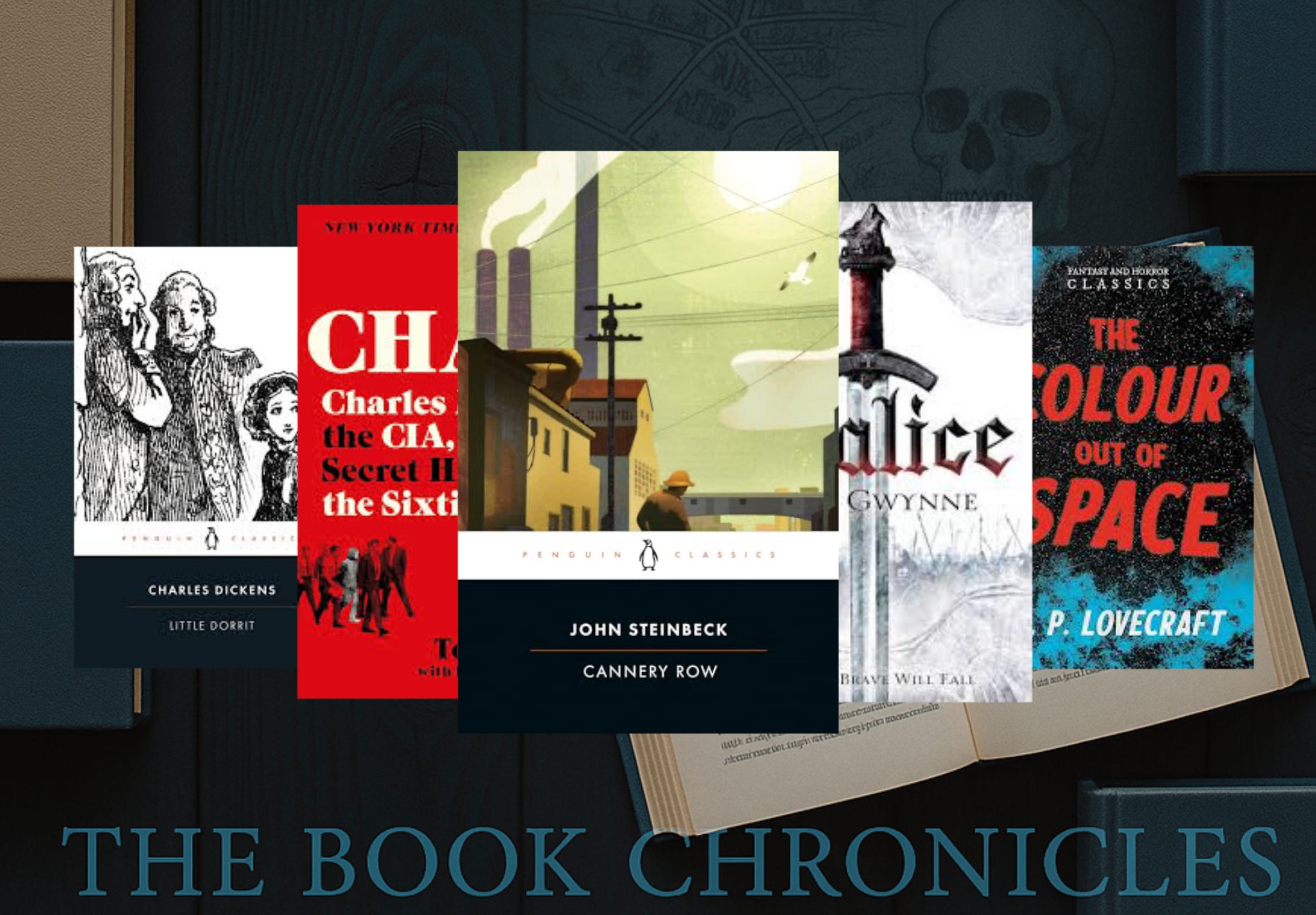
It was a month of two parts. The first two weeks were awful; I finished one book and could not read anything else. The book slump that started in September hit full flow this month.
The cure was not to push it. I watched television and listened to podcasts until I was ready to read again.
The second half of the month was much more productive, and I ended up finishing several books I had started over the months. I am a constant book starter, so it is not unusual for me to have five or six books in progress at once. Every so often, I like to sit and finish these books, so that was what I spent the end of the month doing.
Now, I have a clean start for November!
Chaos - Tom O’Neill ⭐️ ⭐️ ⭐️ ⭐️ ⭐️
For years, the official “Helter Skelter” theory of the Manson murders, famously put forth in Vincent Bugliosi’s book, always felt like it had too many gaps to me; it just didn’t make sense. Tom O’Neill’s Chaos uncovers exactly why.
This is a truly fascinating book, the result of two decades of meticulous, excellent research. O’Neill’s investigation suggests that, fundamentally, everything we know about the Manson murders is a lie shrouded in cover-ups.
The book’s deep dive is shocking, as it explores the possibility that Manson had ties to the CIA’s mind-control programme, MKUltra. O’Neill questions whether Manson was an informant or even a product of these experiments, potentially explaining the mysterious power he held over his followers.
Chaos is a compelling and unsettling read. It’s absolutely compulsory reading for any true crime fan looking for the complete, unvarnished story behind one of history’s most notorious crimes. It is going to take me months to unravel everything I learned.
Cannery Row - John Steinbeck ⭐️ ⭐️ ⭐️ ⭐️ ⭐️
I genuinely wonder if I will ever read a John Steinbeck novel that isn’t a five-star experience. I haven’t yet, and Cannery Row continues that perfect streak.
This novel is beautiful, melancholic, and deeply human. While there isn’t a tight plot driving the narrative, that’s precisely its magic. Steinbeck crafts a series of luminous tales centred around a cast of unforgettable characters, most notably the philosophical marine biologist Doc and the lovable group of bums, Mack and the boys.
What I love most is how Steinbeck finds humour and grace in the lives of those often overlooked.
As always, I hated it when this Steinbeck novel finished; I always want more. The great news this time is that there is a sequel!
Knowing that Sweet Thursday exists gives me something wonderful to look forward to, but for now, I’ll savour the quiet brilliance of Cannery Row.
If you haven’t visited this world yet, you are missing out on one of the great American novels. If you haven’t read any Steinbeck, then you are missing out on a masterclass of writing.
The Colour Out of Space - H.P. Lovecraft ⭐️ ⭐️ ⭐️ ⭐️
H.P. Lovecraft’s short story, The Colour Out of Space, is a masterful piece of horror that proves terror doesn’t require a drop of gore to be deeply unsettling. It’s a supremely well-written tale that slowly draws you into a slow-burning nightmare of cosmic dread.
The horror in this story is purely psychological and environmental, focusing on the corruption of the familiar. After a strange meteorite crashes on a remote New England farm, an inexplicable phenomenon begins to poison the land, the crops, and eventually the residents of the Gardner family.
The core of the terror is the colour of the entity or force from outside our reality. It’s a shade that exists outside the visible spectrum, making it truly alien and unknowable.
Lovecraft expertly uses this concept of the unknowable to deliver a uniquely scary, without being gory, journey. The story doesn’t rely on blood or jump scares; instead, the fear builds from the accumulation of bizarre, subtle changes.
Malice - John Gwynne ⭐️ ⭐️ ⭐️ ⭐️
Starting Malice, after devouring the Bloodsworn Trilogy, may have meant I expected too much initially. I must admit, it took me longer to get into the world of the Banished Lands than it did with his later work. The scope is massive, and Gwynne takes his time building the world and setting the stage for the prophecy.
However, once the initial groundwork was laid, the book transforms into an unstoppable force. By the end, I was totally addicted. The pace accelerates relentlessly, pulling you headlong through battles, betrayals, and the harsh realities of a world spiralling toward war.
I absolutely love the main character, watching him grow from an ordinary boy into someone with the strength to face impossible darkness is amazing.
Gwynne also earns his reputation for high stakes. This book is certainly not afraid to kill off some big characters, raising the emotional bar and making every skirmish feel genuinely perilous. Or did he? The ambiguous fate of certain figures ensures that the ending keeps you guessing.
Speaking of endings, the conclusion offered that familiar feeling that leaves you wanting more. It’s the perfect launchpad for the rest of The Faithful and the Fallen series.
Ultimately, you have to remind yourself that this epic, sprawling tale is a hell of a debut novel, given the depth of the world-building, the cast of characters, and the sheer momentum of the final third. I can’t wait to read more!
Little Dorrit - Charles Dickens ⭐️ ⭐️ ⭐️
Charles Dickens’s Little Dorrit captures the essence of Victorian England.
Like many readers, I absolutely love Dickens’s prose, though I recognise that in places, it is very wordy.
The novel is divided into two parts, and I enjoyed the poorer part more than the richer. The early setting in the Marshalsea Debtors’ Prison, where we meet the “Child of the Marshalsea” Amy Dorrit, is where the story shines brightest.
The depiction of institutionalised poverty and the strange society that flourished within the prison walls is heartbreakingly precise.
The narrative’s energy dips slightly when the characters are later thrust into prosperity, revealing the profound truth at the novel’s heart.
Dickens’s strong message that money can’t make you a better person or happy is perhaps nowhere clearer than in Little Dorrit.
This aligns with most of his other novels. Most of his books end with the quiet, less prosperous life being the morally and emotionally superior choice.
Ultimately, this novel is a profound lesson in social history. Dickens always teaches you something about Victorian life.
Tell me in the comments what was your favourite read of October?
Until next Friday: Read to learn. Read to escape. Read to smile.