

Long before I started writing Murder Mayhem UK, history and crime were my passions. Over the years, I have read many books on the subject. My normal reading routine is to have a fiction book and a non-fiction book on the go at any time.
My non-fiction reading has guided my writing life and taught me much about the world. It was challenging to choose a definitive five that were the best history reads, and I’m sure if you asked me in a year, the list would have changed.
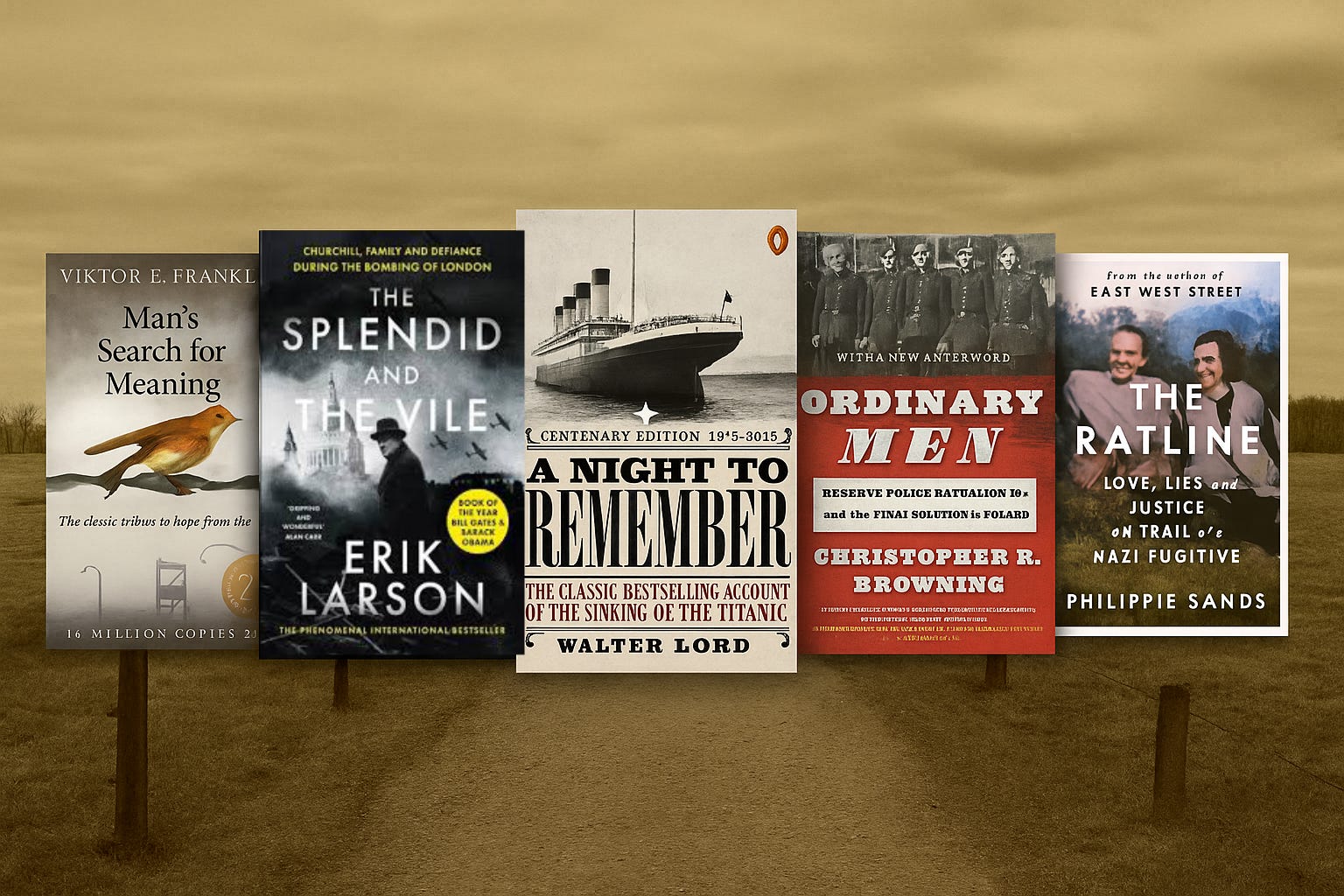
As of this moment, these are the five history books you should read. All are suitable for people with even the most basic knowledge of the period and read more like fiction than a textbook.
Man’s Search for Meaning – Viktor Frankl
I have devoured books by survivors of the Holocaust. Some, such as The Tattooist of Auschwitz, were sold as factual only for us to find out they were fiction. Regardless, every one of these books teaches us something about life for a Jewish person during the Holocaust. Man’s Search for Meaning is the best.
This book should be compulsive reading whether you are interested in history or not. Man’s Search for Meaning is a powerful psychological memoir that explores life inside Nazi concentration camps.
Frankl shows that prisoners who found reasons to live, despite unimaginable suffering, had a better chance of survival. A psychiatrist by profession, he recounts his own experiences in Auschwitz and other camps, using that to illustrate his belief that humans can endure almost anything if they have a purpose.
The first part of the book is a heartbreaking, horrific memoir that shows the concentration camps like never before. Some readers might choose to stop reading there.
The second half introduces logotherapy, Frankl’s theory that the primary human drive is not pleasure (as Freud suggested) but the pursuit of meaning. Whether through work, love, or suffering, Frankl argues that meaning can be found in all aspects of life, even the darkest.
This is a book that not only taught me about the horror of the camps but left me with a message I still use today.
The Splendid and the Vile – Erik Larson
Erik Larson is my favourite history writer. His books are powerful depictions of history, written in a way that makes you feel you’re reading a novel. If you’ve read The Devil in the White City about H. H. Holmes, you’ll understand what I mean.
The Splendid and the Vile is just as enthralling. It tells the story of Winston Churchill during his first year in government, fighting the Nazis and resisting Hitler’s invasion from 1940 to 1941.
Using information from diaries, letters and archival documents, Larson humanises Churchill. He shows not just the political leader rallying a nation, but the father, husband and flawed man behind the speeches. There are moments when you shake your head at the man and times when you cry along with him.
The book covers Churchill’s inner circle, including his eccentric family and key advisors, all navigating the horror and uncertainty of war under constant bombardment.
One of my favourite stories is how Churchill would ignore advice to hide in a bunker and instead stand on the roof of government buildings, observing the destruction of the Blitz. If only the Germans had known. We then see him walking the streets, talking to those affected and crying along with them.
This book is a story of leadership under fire. It shows how Churchill inspired hope and defiance in the face of destruction, turning Britain’s darkest year into one of its finest. It left me wanting to read more about the great man.
The Ratline – Philippe Sands
If you asked me to pick one history book I think everyone should read, this would be it. It changed everything I thought I knew about World War II and inspired much of the research I’ve done since. Many of the articles I write for Murder Mayhem UK have their origins in this book, this week being no exception.
The Ratline is a gripping true story about the post-war escape routes used by high-ranking Nazis to evade prosecution. It focuses on one man in particular: Otto Wächter, an Austrian SS officer and governor in Nazi-occupied Poland, responsible for tens of thousands of deaths.
After the war, Wächter vanished, evading justice by using the so-called “ratlines” covert escape networks, often involving the Catholic Church and the CIA, which helped Nazis flee to South America.
Sands follows the trail through letters, archives and personal interviews, especially with Wächter’s son, who refuses to believe his father was a war criminal. What emerges is part espionage thriller, part family drama and part legal investigation into how justice was dodged and how history is remembered or rewritten.
It’s a chilling, deeply researched look at complicity, denial and the shadowy paths that allowed evil men to disappear into new lives because governments wanted the information they could provide.
If you’ve ever wondered how people such as Adolf Eichmann, Josef Mengele or Klaus Barbie escaped prosecution to live out their lives in comfort, the answer is this, your government helped them.
Ordinary Men – Christopher R. Browning
Many of us have asked the question. How did the Nazis live with themselves? What made them such brutal killers? This book answers those questions.
Ordinary Men follows the Reserve Police Battalion 101 during the Final Solution in Poland. It is a chilling historical analysis of how average, non-fanatical German men became perpetrators of the Holocaust.
The battalion was made up of around 500 middle-aged men from Hamburg mostly working-class and not hardened Nazis. They were tasked with rounding up and executing Jews in Nazi-occupied Poland. Through a mix of orders, peer pressure and gradual moral erosion, these ordinary men ended up committing mass shootings and deportations to death camps.
Browning uses survivor testimony, trial records and official documents to dismantle the idea that only fanatics commit atrocities. Instead, he shows how regular people, given the right conditions and lack of accountability, can become complicit in genocide.
It’s a disturbing but essential read that forces readers to confront how evil often wears an everyday face. If you’ve ever wondered whether the Holocaust could happen again, this book shows that with the right conditions, the answer will always be yes.
A Night to Remember – Walter Lord
There is no denying that my passion lies in World War II, as the first four books on this list show. However, another area of history that fascinates me is the sinking of the Titanic. I have loved stories about the fated ship ever since I saw the stunning first photos of it under the water as a child.
This book is the best on the subject, even though it is largely overlooked. Published in 1955, A Night to Remember is a meticulously researched, dramatic retelling of the Titanic’s final night on 14–15 April 1912. Lord interviewed dozens of survivors and drew from firsthand accounts to reconstruct the sinking in vivid, almost minute-by-minute detail.
The book was one of the first to challenge the myths and glamour surrounding the Titanic, highlighting not just the tragedy but also the human failings, hubris, class division and poor decision-making that contributed to the disaster.
It is one of the clearest narratives showing that whether you survived or not largely depended on your class. Of 324 first-class passengers, 201 survived, compared with 181 out of 708 third-class passengers.
It remains a definitive and influential account of the Titanic sinking, and it inspired both a successful 1958 film and generations of further research.
Honourable Mentions
There are many other books I could have included in this article. Which books you enjoy will largely depend on the period in history you’re interested in.
If Roman history is your passion, I suggest SPQR by Mary Beard. It gives you a solid basis of the era, after which you can dive deeper into any areas that interest you.
For Egyptian history, I thoroughly enjoyed The Rise and Fall of Ancient Egypt by Toby Wilkinson. Again, it offers a well-rounded look at the period and allows you to pick your favourite Pharaoh for further study.
If you’ve always been fascinated with the British monarchy, Mortal Monarchs by Suzie Edge is a fun, quick look at the royal succession line.
Some fiction books can teach you just as much about history. Just keep in mind that they are works of fiction. Two of my favourites set during World War II are The Book Thief by Markus Zusak, one of my all-time favourite books and The Nightingale by Kristin Hannah.
Want a book recommendation? Tell me the era you’re interested in, and I’ll try my best to recommend a good book for you.
Until next week, remember: Read to learn. Read to escape. Read to smile.