

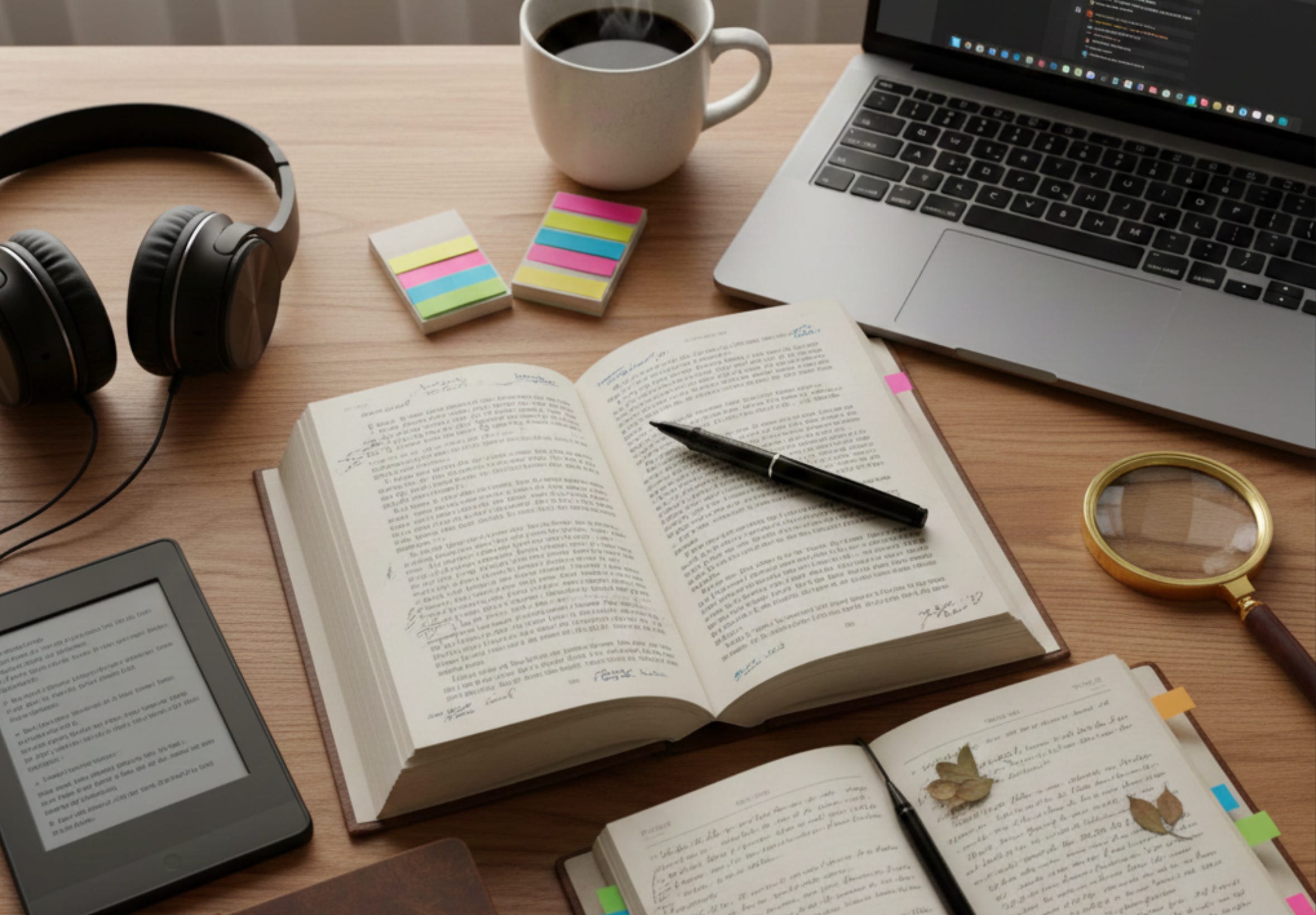
I read for fun and to relax, but a large amount of my reading is also for Murder Mayhem UK, my True Crime and History newsletter. This is why book notes have become so important to me. Many people ask me how I do this, and today I want to share my process with you.
The first thing to say is that I have many different methods depending on the book and the genre. I approach fiction completely differently from non-fiction. For fiction, I read in a variety of formats: audiobooks, eBooks, and physical copies. Non-fiction, however, I tend to stick to physical copies to aid my process.
The first tip is the most important: When you read something that makes you stop in your tracks, write it down. This could be a powerful piece of prose, a striking fact, or just the precise way an author has phrased something.
My Process for Fiction Reading
Ninety per cent of the fiction I read is for pure enjoyment. That is not to say that I do not take book notes on them, but they are fewer if I am not directly using them for my writing.
When I find a quote or piece of prose I want to save, I highlight it. On a Kindle, this is easy. On a physical copy, I use a little sticky tab which I can go back and collect later. Audiobooks are a little more difficult, and that affects the books I choose to listen to. I bookmark the passage and then try to find it in the text later.
The other 10% of my fiction reading is books like Far From the Madding Crowd and David Copperfield. I am researching a book on Victorian England, and sometimes fiction can tell us just as much about life as non-fiction. For these, I will tab the pages and write notes after every chapter if necessary.
My Process for Non-Fiction Reading
Now I fear I may have some of you shutting the article down at this point! I destroy my non-fiction books, but in my defence, I come back to them time and time again and am never going to pass them on to anyone else.
I read with a pen in my hand. I mark passages, I write notes in the margins, and I summarise every chapter at the end in three to four sentences. And, as if I have not committed enough bookworm crimes, I then dog-ear the pages I have marked so I can find them again.
Non-fiction books are a conversation between the author and me. I also have to admit to really liking the well-read look my books take on.
When I Finish a Book
Once I have finished a book, I let it sit for a week to give myself some distance from it. This helps clear my mind and gives me a fresh perspective on what is relevant and what is not.
Fiction: Quotes and amazing pieces of prose go into my reading journal so I can look back on them sporadically and revisit some of my favourites.
Non-Fiction: I write a full book note on everything I have collected that remains relevant after a week away from it. I use a markdown program called Obsidian. You can use any format you like; however, I would suggest typed is easier.
When this process is over, I go back through the notes and pull out parts that can go into articles or books I am writing. Most of what I have collected will be used somewhere because, for me, that is why I read non-fiction. You may be different, but I would still say that unless you write your own thoughts down about what you have read, you will forget it.
For the Uncomfortable Bookworms
The last thing to say is I understand how some of you might be uncomfortable writing in your books—again, this is personal preference. If this is you, treat your non-fiction how I do my fiction: use sticky tabs and a notebook.
Everybody will have a different method, but for me, taking booknotes is a crucial part of my reading and self-development journey.
Until next Friday: Read to learn. Read to escape. Read to smile.