

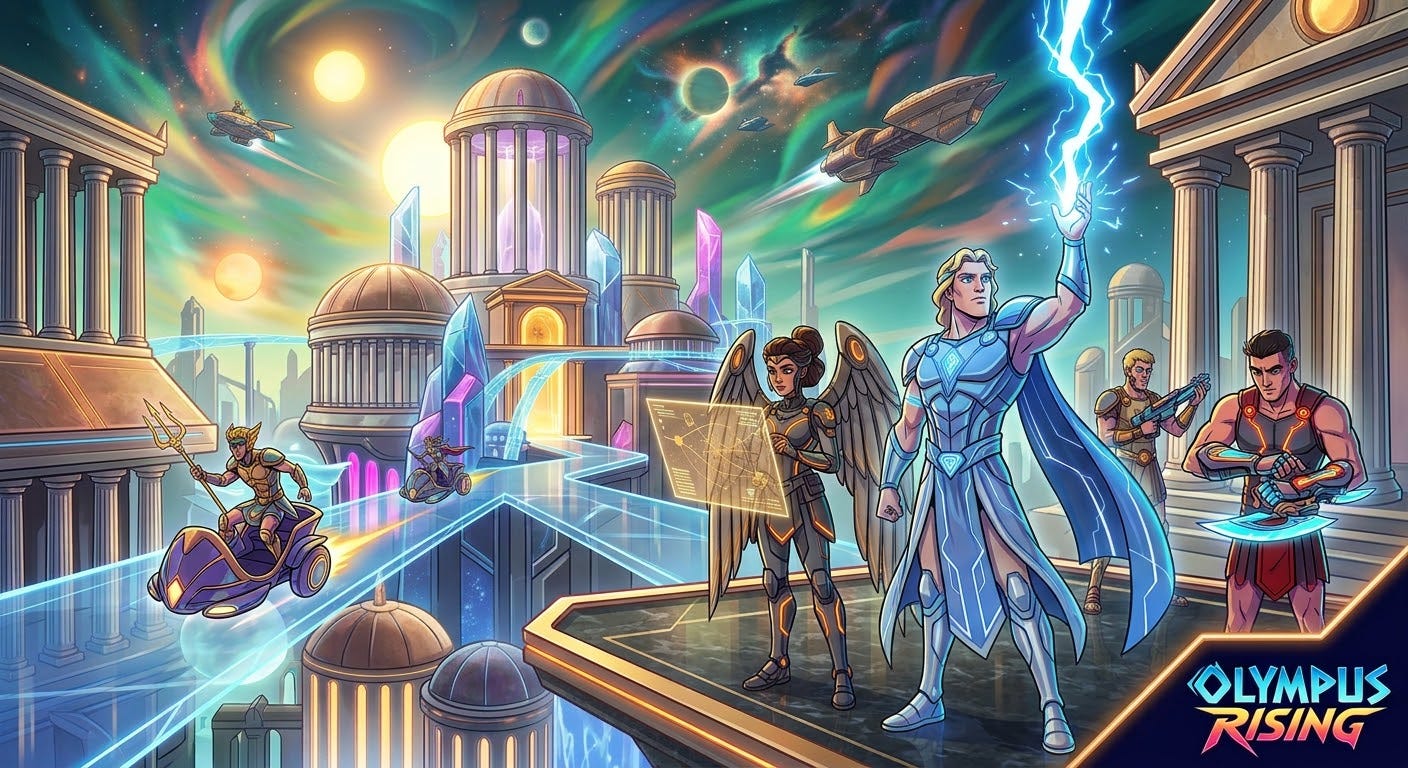
Just before we look at how Greek mythology has affected our language today, an announcement.
I’ve launched a podcast for Murder Mayhem UK. You can find it on your podcast app or on my main page. If you prefer visuals, subscribe to my YouTube channel for graphics on the same topics.
I’d be delighted to have you over, and I’d be grateful for any helpful advice you can offer.
Now on to the main part of the article.
Greek mythology has been talked about a lot recently with the release of the new Odyssey film, which I haven’t seen but plan to. Most of my knowledge of these tales has come from the amazing Stephen Fry, and I urge you to pick up any of his books if you want to read more.
Whilst reading his books, though, I was struck by how much of modern language has been shaped by these tales—shaping not just our vocabulary, but astronomy, psychology, science, and everyday idioms.
Planets
Whilst most of the planets in our solar system bear the names of Roman gods, it is worth remembering that the Romans mapped their pantheon directly from the Greeks.
Mercury is the Roman name for the Greek god Hermes, the swift-footed messenger of the gods. If you are in the UK, you will also know that a popular delivery service used his name (now rebranded as Evri).
Venus is named after the goddess of love and beauty; in Greek mythology, she is known as Aphrodite. Mars is the god of war, named after Ares. Jupiter, the biggest planet in the solar system, is named after the king of all the gods, Zeus. Saturn is named after Cronus, the Titan who went rogue and tried to swallow his children Zeus, Poseidon, and Hades.
Uranus is the only major planet named directly after a Greek deity, Ouranos. Whilst Gaia ruled the earth, Ouranos represented the sky. The outer reaches of our solar system feature Neptune (named after Poseidon) and the dwarf planet Pluto (named after Hades).
Several moons associated with these planets are named after secondary figures and deities from Greek mythology.
Language
Greek mythology has also influenced our language beyond the planets.
Are you frightened of spiders? Arachnophobia is derived from Arachne. Arachne was a mortal who wove beautiful tapestries. She was foolish enough to challenge Athena to a weaving contest. When her work proved flawless, Athena transformed her into a spider out of spite so she could forever weave her webs.
Narcissus was a hunter who, through the trickery of the gods, fell in love with his own reflection in a pool. In the tale, he lost his will to live and turned into a flower. This is where the term narcissism comes from.
Zeus was notorious for his affairs, and one of the nymphs he pursued was Echo. When Hera, his wife, discovered how Echo distracted her during his infidelities, she cursed Echo to only ever speak the last words spoken to her.
Pan was the goat-legged god of nature whose shrieks in the forest would cause terror to passing travellers; you could say it caused panic.
Finally, we have the Achilles’ heel. According to legend, when Achilles was an infant, his mother, the nymph Thetis, dipped him into the River Styx to make him invulnerable. However, she held him by his heel, leaving that one spot untouched by the magic waters—creating his only vulnerable spot.
I am fascinated with how literature shapes our language, don’t even get me started on Shakespeare. These are just a few places where Greek mythology has shaped our language; there are many more. Atlas, who held up the heavens and whose name became a book of maps. Pandora’s box, which none of us should open.
I hope you have enjoyed this trip into the great Greeks. Let me know in the comments if you know of other sayings.
Until next time: Find the time, find the words, find the way.
Sam 😊
Recent Murder Mayhem UK Articles

Drop me a comment: Do you have a writing related question you need answering.
Subscribe today: If you enjoyed this article then consider subscribing for more
