

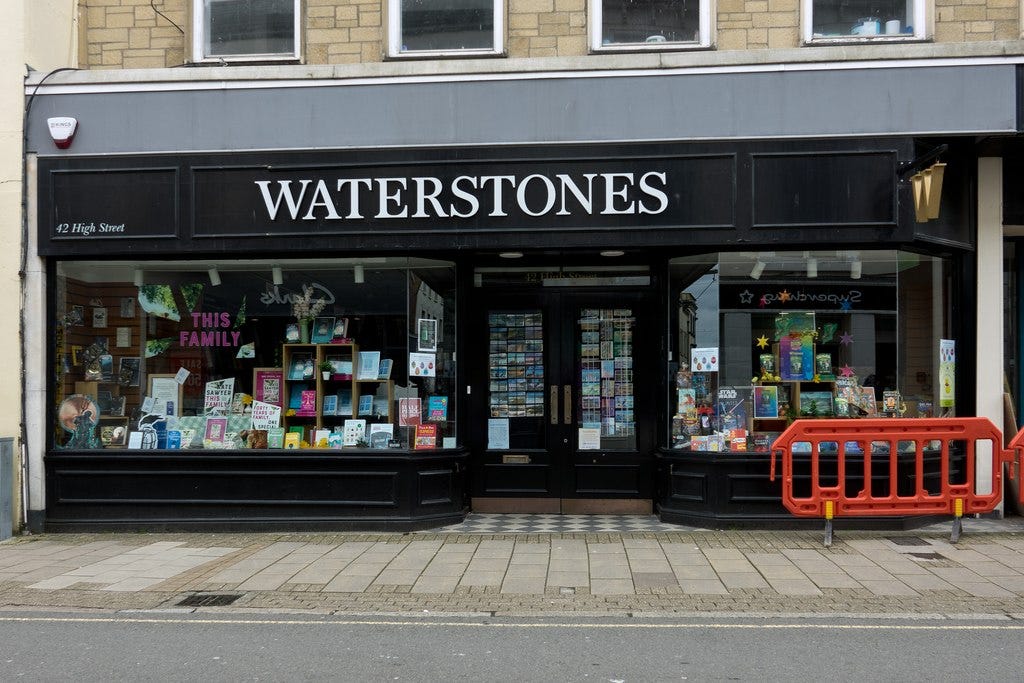
If you walked down a British high street in 2011, it felt like a graveyard. Retail giants were vanishing overnight. Woolworths had collapsed, Zavvi was gone, and Waterstones stood in the firing line.
Waterstones looked like a dead man walking.
It was a bloated, expensive chain of superstores selling a product that everyone was now buying on a Kindle.
The thinking was that with the Kindle launching globally; ”promising a future where you could carry a library in your pocket” along with the iPad offering the ability to read books, buying physical books would soon be obsolete.
To top it off, its owner, HMV, was collapsing as digital downloads began to take over its market share. The Waterstones shops were a mess, and analysts were sure the chain would be dead by 2014.
But that’s not what happened. If you are a bookworm like me, I would guess you are still spending much of your time in Waterstones, sniffing the books and browsing the shelves.
The books are not cheaper than Amazon, yet there is something that makes us come back and pay that little extra; all for an experience.
This is the story of how a failing business looked at the digital threat and decided to do the exact opposite of what everyone expected.
Things Fall Apart
By the late 2000s, under the ownership of HMV, Waterstones was suffering from a severe identity crisis. It’s known mostly for being a bookstore, yet it was acting like a supermarket.
The store was using a system of centralisation. Basically, in all 300 stores, the format was the same. A team of experts in a glass office in London decided what everyone should experience.
Jack the Ripper was not showcased in London, stories of coal mining were not prioritised in Wales, and local authors were all but ignored.
The suits in head office sent out strict, non-negotiable diagrams that told every shop manager exactly where to place every single book. This meant that if you walked into a Waterstones in Glasgow, you saw the same recommended table as you would in Cornwall.
There was a bigger problem, though: the powers were making money wherever they could at the expense of the reader. Every inch of the shop; ”from the window to the first display as you walked in” was available to the highest bidder.
Publishers were handing over nearly £27 million a year to rent these spaces, creating a system where a mediocre celebrity biography could dominate the front of the store simply because someone wrote a cheque to put it there. The shops became cluttered with books no one wanted to read.
Struggling for cash in 2011, HMV put Waterstones up for sale. That was when an unlikely saviour stepped in: Alexander Mamut, a Russian billionaire with a passion for British literature. Thank God for Mr Dickens. Mamut paid £53 million, which, for a chain that had 300 stores in prime locations, was considered a steal.
The Redeemer
Mamut could have poached a CEO from Gap or Marks and Spencer, but instead he knew he needed a man who understood readers. He went to Marylebone High Street and recruited the exact opposite of corporate.
James Daunt was a man who had quit finance to open Daunt Books. His flagship store was a sanctuary of long oak galleries and skylights. Books were arranged by country, and visitors were encouraged to browse and discover. He cared about the physical beauty and the experience of the customer. He was also hugely successful with this approach.
When the news broke, many in the industry laughed. Mamut had effectively hired someone who had only ever managed six shops. However, both men were unperturbed.
Brave New World
Daunt soon realised that everything about Waterstones was wrong. The first task was to convene the regional managers. He announced that he was relinquishing consistency and operational decisions, entrusting them to individual store teams.
He understood the simple concept that what flies off the shelves in a wealthy London suburb is often completely different from what sells in a working-class town in the north.
To prove he was serious, he announced that they needed to decide where the tables went. In theory, you would have thought that these bookstore managers would jump at the chance, but most of them had no passion and were terrified of the change.
Daunt had a solution for this, too. He undertook a brutal restructuring involving firing half of the managerial staff. He removed the layers of middle management who were only there to enforce the rules and replaced them with booksellers and people who actually read. He wanted people who could argue with customers about the ending of a novel and recommend books, effectively giving each store its own personality.
Hard Times
Daunt, in a surprising move that immediately reduced his balance sheet by £27 million, halted publishers from paying for prime store areas.
Daunt argued that the money wasn’t actually free because it came with the hidden cost of being forced to stock bad books. He reasoned that if you stock bad books, you lose the customer, and if you lose the customer, you lose the business. So he told the publishers that if they wanted their book on the front table, they had to write a better book.
This shifted the power dynamic entirely, meaning the front tables were now reserved for books that the booksellers actually believed in.
If a manager in York loved a weird, obscure book about the history of the Vikings, they could stack it high on the front table. And because they could look a customer in the eye and honestly say, “It’s fantastic,” the books actually sold.
A Room of One’s Own
Once the shops were selling books people wanted to buy, Daunt turned his attention to the physical environment. The stores were far from inspiring, with wide, straight aisles flanked by drab, anodyne, and badly stocked shelving that made the space feel intimidating rather than appealing.
Daunt initiated a massive refurbishment programme based on the simple philosophy that if you want people to leave the comfort of their homes, you have to offer them a destination worth visiting. Amazon’s got value covered; Waterstones needed to offer beauty and atmosphere.
To achieve this, the industrial metal shelves were ripped out and replaced with thinner oak tables, while the aggressive lighting was swapped for warm, soft LEDs that mimicked a library setting.
They laid down carpets, added comfortable armchairs, and introduced curves to the floor plan to break up the rigid grid, effectively forcing customers to slow down and meander through the space.
The goal was to make these stores feel intimate, breaking up the vast square footage into nooks where a customer could pick up a book and lose track of time.
This philosophy extended to the branding itself. In towns with historic buildings, Daunt allowed the stores to lean into their architectural heritage, most notably in Southwell, where the shop doesn’t even carry the standard branding above the door, allowing it to masquerade as a local village bookshop.
If you have ever spent two hours wandering the shelves in your local Waterstones, you know this has worked.
Sleeping with the Enemy
Despite this change, digital downloads continued to haunt the book industry. In 2012, Daunt did something that left many in the industry scratching their heads. He partnered with Amazon to sell the Kindle in his stores. Staff were shown how to train even the most reluctant customer in using their new gadget.
People questioned why you’d invite the fox into the hen house. Why would you sell the very device designed to put you out of business? But Daunt’s logic was pragmatic. He believed that if his customers were going to read digitally, he wanted them to associate that experience with Waterstones.
This was where the bookworms took matters into their own hands.
Over time, sales of e-readers began to plateau. The growth that “experts” had promised flattened out. Simply put, a Kindle does not smell like a newly cracked paperback.
Readers’ favourite book format was physical, not digital, as I asked them.
By 2015, Waterstones quietly removed the Kindles from their stores. Daunt admitted that the sales were pitiful, but the experiment had served its purpose.
I think Amazon is actually a fabulous thing for books... But they are a website, self-evidently. They have a single proposition... they by definition are absent what we can do within bookstores, which is the serendipity of illogical choice. - James Daunt
The Winners
In 2016, Waterstones reported that the finances of the business were healthy and improving every year.
In 2018, they bought Foyles, one of London’s most legendary bookstores. Daunt did the exact opposite of what usual logic suggests: he kept the name, kept the brand identity, and left the front-end personality alone because he realised the Foyles brand had value because it meant something to Londoners.
During the same year, Elliott Advisors bought a controlling stake in Waterstones. In 2019, Elliott acquired Barnes & Noble, the struggling American giant, and they put James Daunt in charge of that too.
Daunt was now effectively the CEO of the English-speaking world’s physical book market. He began applying the same Waterstones logic to Barnes & Noble, clearing out the clutter and empowering local managers in Nebraska and Ohio to order what their communities wanted.
Then came 2020. The COVID-19 pandemic presented a terrifying challenge, but the years store managers spent embedding themselves in their local communities created a reservoir of loyalty. Lockdown-driven traffic surged to their website.
As the world reopened, the book market was hit by a tidal wave of demand from a completely unexpected source: TikTok. A corner of the internet dubbed “BookTok” began driving sales with a ferocity that traditional marketing couldn’t match. For this generation, the book became an aesthetic object and a status symbol. Waterstones found itself accidentally perfect for this moment. James Daunt’s decade-long crusade to improve lighting and install beautiful oak tables meant that when influencers arrived, the stages were already built for them.
In 2022, they did it again by acquiring Blackwell’s, an institution in Oxford and Cambridge. By keeping the brands separate, he could dominate different segments of the market without diluting the identity of his core business, yet still keep growing the profit margins.
By 2024, Barnes & Noble announced they were expanding, opening new stores in locations where Amazon had previously decimated the competition.
Great Expectations
This new wave of book lovers showed themselves again in August 2025 during the annual bookfest at the Piccadilly flagship, where thousands of fans descended upon the store, creating queues that wound up the stairs and spilt onto the streets. This chaotic stampede proved that the next generation had fully embraced print with fanaticism.
Today, Waterstones proves that the so-called retail apocalypse was never a natural disaster but a failure of imagination by retailers who died because they treated their customers like data points rather than people.
By treating the bookshop as a destination for leisure rather than just a warehouse for inventory, James Daunt proved that buying a book is a special experience that a “buy now” button can never truly replace and I, for one, am very grateful.
Waterstones is more than just a bookstore to me; it’s an experience of exploring the shelves and meeting new friends who will stay in my mind for years. Waterstones is a home away from home.
Recent Murder Mayhem UK Articles

Drop me a comment: Do you have a writing related question you need answering.
Subscribe today: If you enjoyed this article then consider subscribing for more