

I am constantly fascinated by the writing routines of writers. Mainly because I am trying to squeeze hours in wherever I can. Oh, to have the time to write full time! How would I organise my day?
The writing routines that entertain me the most are the ones from writers that I admire. My favourite author at present is John Steinbeck. I am slowly making my way through his canon. So it was with fascination that I discovered how he produced classics such as East of Eden and The Grapes of Wrath.
Steinbeck approached his writing as a gruelling 9-5 job rather than an artistic calling. He believed in intense discipline and treated his desk as a factory workbench.
He would spend many hours deep in the zone, especially when he was writing his two masterpieces mentioned above. For a writer, he had a remarkably strict routine; one we could all take something from.
Early Morning Warm-Up (7:00 AM - 8:00 AM)
Compared to many writers, Steinbeck was an early riser. Once awake, he would have a quick breakfast, which largely consisted of black coffee. By 7:30, he sat at his desk.
However, he did not start writing at this point. Before working on his current masterpieces, he would force himself to go through his warm-up routine. He would open his journal and write a full page of stream-of-consciousness prose. Similar to morning pages that Julia Cameron made famous.
In these entries, he would complain about his backache, worry about his dogs, and generally detail his anxieties. This process cleared his mind and warmed his hand for longer writing sessions.
Narrative Sprint (8:00 AM - 1:00 PM)
Steinbeck would then write straight through for roughly four to five hours. He had a strict quota of two thousand words, which worked out as roughly four pages of his large ledger.
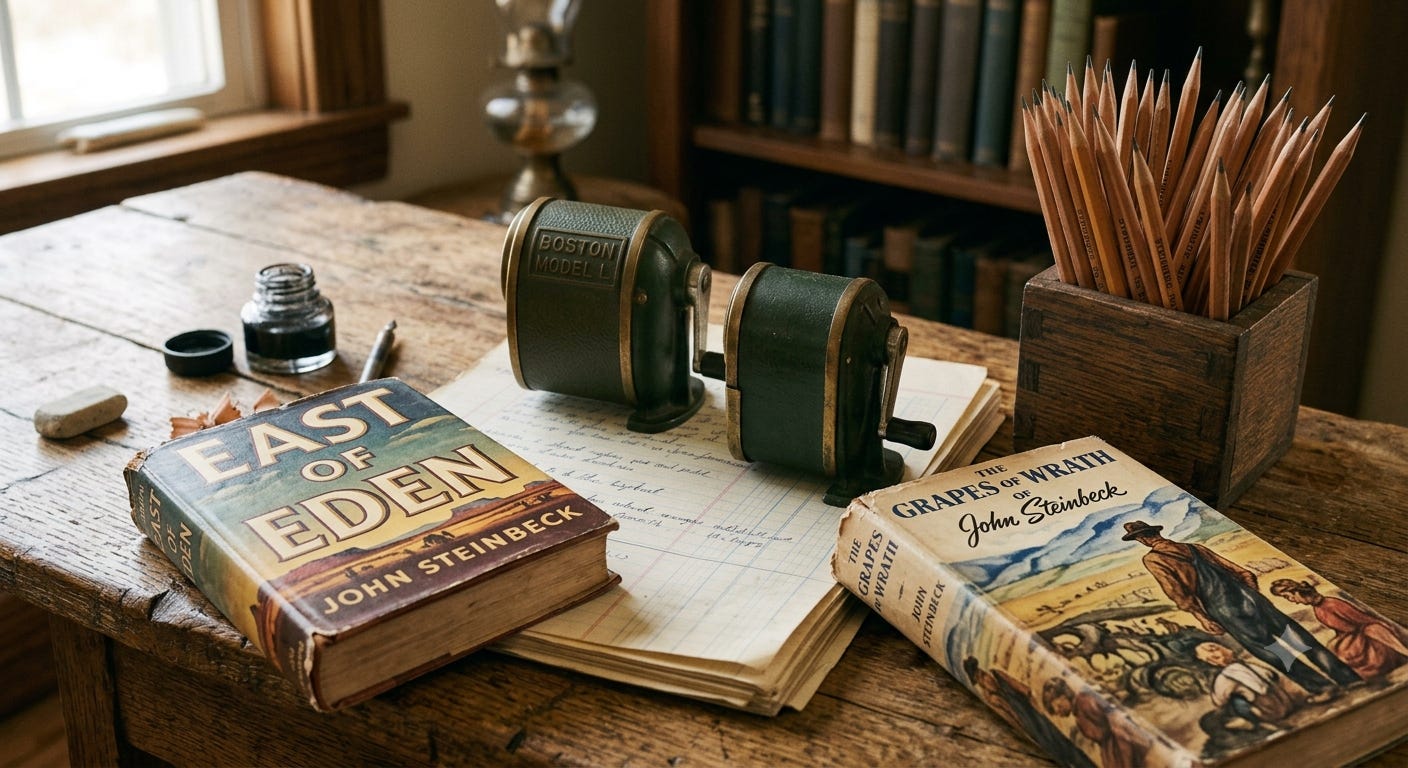
He was very superstitious about his writing and the tools that he used. He hated typewriters because he said the mechanical noise interrupted his train of thought. He wrote by hand using wooden pencils.
In the morning, his routine would begin with sharpening twenty-four to thirty-six pencils and placing them in a box. It was a routine that Roald Dahl also used. Once the pencil went dull, he would drop it in a box and grab a fresh one. It is estimated he used , more than, three hundred pencils to write East of Eden.
He preferred writing on large, heavy ledger paper. He loved the colour of yellow legal pads or cream-coloured ledger sheets because white paper reflected too much glare under his desk lamp and made his eyes ache during his morning sprints.
During this process, he refused to stop or look back until he had reached the two thousand words. He never edited as he wrote, as he believed this destroyed his organic rhythm.
His first draft was completed before he rewrote or edited anything.
Physical Labour (1:00 PM - Evening)
By the afternoon, Steinbeck was mentally exhausted. He believed writers had only a few hours of true creative energy daily, and forcing longer sessions resulted in poor work.
Like Dickens, who used to take an afternoon stroll, Steinbeck preferred physical labour in the afternoons. He would garden, build furniture, repair the house, or go for long walks.
This physical work allowed his subconscious mind to process the next day’s plot points without active strain. It is similar to going for a walk when you are stuck on a project.
For years I have looked for the perfect pencil... I found one the other day made by Eberhard Faber... It is very soft and will not hold a point past a legibly written page... but the blackness of the line is a joy. - John Steinbeck, Journal of a Novel
It is clear, by the books he produced, that Steinbeck’s routine worked extremely well for him. As with all writers, we can all take something away from his routine and add it to ours.
What is your writing routine?
Recent Murder Mayhem UK Articles

Drop me a comment: Do you have a writing related question you need answering.
Subscribe today: If you enjoyed this article then consider subscribing for more