

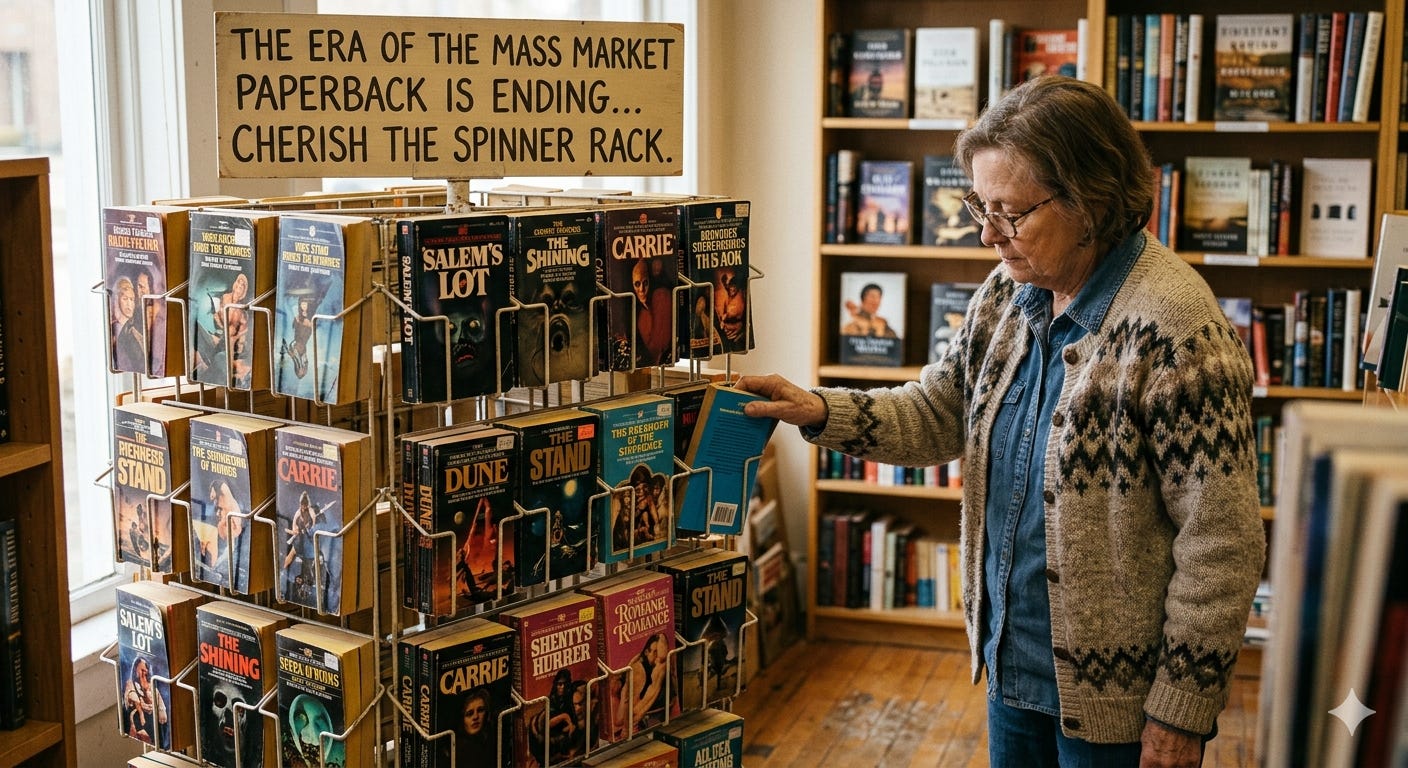
The era of the traditional mass market paperback (MMPB) is effectively coming to an end. While a few publishers still utilise the format for specific legacy genres, a series of industry shifts between 2024 and early 2026 has signalled its near-total phase-out.
In my opinion, this is incredibly sad. The MMPB has made reading accessible to all; therefore, anything that reduces people’s ability to read must be considered a bad thing.
What is a Mass Market Paperback?
An MMPB is a small, pocket-sized book designed for high-volume sales at a low price point. Historically, they were the ‘disposable’ version of the publishing world. They were perfect to shove into a back pocket or bag to read in those little moments.
Once read, you could easily recycle them or, my favourite, pass them on.
They were not the best quality books. With their low-grade paper and glued pages, they would never make an attractive bookshelf edition, but they were cheap and easy to get hold of.
What truly made a book ‘mass market’ was where it was sold. Unlike hardcovers, which were primarily sold in specialised bookstores, MMPBs were designed for ‘non-traditional’ retailers:
Grocery stores and supermarkets
Drugstores (CVS, Walgreens)
Airport newsstands
Train stations and bus terminals
Gas stations
What made them popular with retailers was the return system. Rather than shipping the whole book back to the wholesalers, shops could send the cover and receive a credit. The rest of the book could then be recycled.
The most popular genres for these books were romance, science fiction, fantasy, crime, and thrillers. Many people started reading because of these cheap alternatives to hardcovers. They also made many authors popular.
Stephen King
While Stephen King’s debut, Carrie, saw a modest initial hardcover release, it was the record-breaking $400,000 sale of its paperback rights to New American Library that truly ignited his career.
The spinner rack accessibility of MMPBs allowed King’s early masterpieces— Salem’s Lot, The Shining, and The Stand, to bypass the gatekeeping of elite bookstores and land directly in the hands of millions of commuters and casual readers.
By saturating the market with affordable, portable editions that featured iconic, tactile cover art, the mass market format transformed King from a struggling teacher into a cultural phenomenon. This ensured his name became synonymous with the modern horror genre in every household across the country. He himself has spoken about this and how the sales from these books transformed his life.
So Why Phase Them Out?
The most significant blow to the format occurred at the end of 2025, when Readerlink, the largest distributor of books to mass merchandisers like Walmart, Target, and Kroger, officially stopped distributing mass market paperbacks.
Readerlink had an estimated 60–70% of the market and locations for these books. Sales plummeted because the eBook industry likely replaced the “quick read” market that MMPBs once dominated—dropping from 131 million in 2004 to just 21 million in 2024.
Following this, most major publishers shifted their ‘entry-level’ physical books to Trade Paperbacks (larger, higher-quality paper) or digital formats. Companies such as Penguin Random House and Harper Collins have moved from MMPB to the more expensive Trade Paperback because the larger format offers higher profit margins and fits more easily into modern production lines.
Furthermore, the rise of ‘BookTok’ and the aesthetic side of social media has changed what readers want. Books are now often seen as decorative objects for a ‘shelfie,’ and the flimsy MMPB doesn’t look as good on camera as a sturdy Trade Paperback.
Publishers state that, with rising costs, they could not keep the price as low as people had become used to. To justify increasing the price, they increased the quality of trade paperbacks, pricing some books as high as £18.99. They also state that these more expensive books last longer.
Reader Effect
Look carefully and you will still find some MMPBs from authors such as Danielle Steel and John Grisham as publishers exhaust their supplies. However, unless we as readers do something, the end of the MMPB seems imminent.
This decline is one more example of readers increasingly finding it difficult to have access to literature. Ebooks are priced almost as much as their physical relatives, and paperbacks are becoming as expensive as hardcovers. If you are a vivacious reader, you could be spending hundreds of pounds.
Reading should be for all, regardless of your income. Make sure you purchase those MMPBs when you see them; show the industry they are wrong to phase them out. Tell your reading friends about this, as it is something the industry is reluctant to publicise. And if all else fails and you can’t afford to read—remember there is always a library.
Until next Friday: Read to learn. Read to escape. Read to smile.