

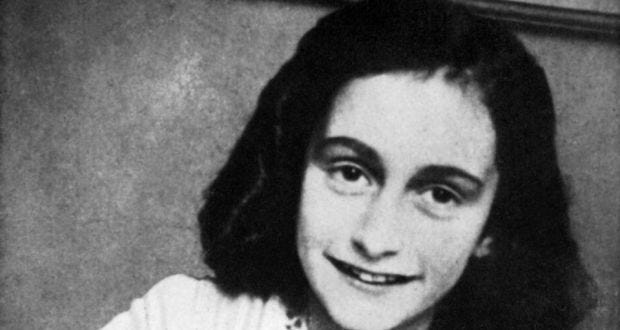
Anne Frank was the first to introduce me to the holocaust as a child. We sat down as a family every Sunday to watch the television show. My mum answered all my questions, and slowly I learned.
This started a lifelong obsession with historical stories from those who had lived through the worst humanity can throw at them.
When I became a teenager, I read her diary several times. Five years ago, I visited the annexe she shared with seven others, which profoundly affected me.
It was as quiet as a graveyard, yet it still seemed to hold some of the personalities that lived there. There were moments when you had to remind yourself that this happened; this wasn't a set from a film, but the home to seven persecuted souls.
As you walk around, you see the pictures left on the walls. You put your hand on the chair that Anne was dragged out of by the Germans, and you wonder how seven people survived in what is little more than a cupboard.
Regularly, I read her diaries to remember what happened to thousands. However, I did not realise until recently that there are three copies of Anne's diary, which have been fought over since World War II.
The conflict in Anne's life did not end when she died in Auschwitz.
The Original Diary
Anne told stories of her birth in Germany in 1929 in her diaries. She then details how her family moved to Amsterdam as Hitler came to power and the decision to hide in a secret annexe at her father's place of work.
Anne originally started writing her diary as a way to cope with the situation she was in. Limited space allowed her to escape the fear and share her thoughts.
She originally started writing this in a red and green checkered journal that her father had given her on her 13th birthday. Once she filled this, she went to other notebooks and anything she could find.
The Edited Diary
In 1944, the family sat listening to the radio when they caught a broadcast that urged citizens to keep written records of what they lived through during the war.
This was to form a historical record of the people who knew best.
Then, Anne decided to start turning her diary into a novel titled The Secret Annex. She polished her previous diaries in her new notebook, rewriting and editing passages to make them ready for publishing.
Anne had completed 324 pages of this book before her family was discovered in hiding.
The First Published Diary
It is well documented that Otto Frank was the only person to survive the annexe. When the war ended and he was released, he wanted nothing more than to fulfil his daughter's wishes and have them published.
He, however, edited her diary, cutting out several passages that contained a reference to sex, puberty and writing he felt hurt his family's reputation.
This edited version was published in 1947; this is the edition that became popular around the world. It also resulted in three copies of the diary: Anne's original, her working copy and Otto's published copy.
Missing Pages
It is reported that Otto omitted five loose pages from the diary.
Some of the pages, it is believed, were removed because Anne had used them to voice her anger at her mother and her parents' relationship. They have been seen by a handful of people, including a writer creating a biography of Anne.
Melissa Muller was told that she was not permitted to quote directly from the diary in her biography because it would be considered breaking copyright law.
Conflict
These different versions have led to further conflict between the Anne Frank Fonds, a Swiss foundation with the copyright to Otto's published version, and the Netherlands State Institute, to whom Otto gifted the original diaries.
The Anne Frank Fonds has cited that other organisations have broken copyright law, and they have stated that Fonds is profiting from Anne's life and shares none of the proceeds with other charities set up in Anne's name.
Further, Fonds took legal action against the Anne Frank House Museum to demand the return of letters and other documents from the Swiss Foundation in the case.
Copyright Law
Under European laws, if an author dies seventy years after the work enters the public, it is copyright-free. This would mean that as of 2016, Anne Frank's diary should be copyright-free.
However, Fonds have alleged that because Otto edited the manuscript significantly, he is essential to the book's creator and should be named co-author, extending the copyright. Otto passed away in 1980, meaning the copyright would be extended to 2050.
The thought that either Anne or Otto would want him recognised as a co-author is ludicrous. The institute defends its position by saying it would not like Anne Frank's writing to be exploited through merchandise.
However, many consider that this is the actions of a company that wants to keep making money from a poor girl's legacy. It seems even more horrific that these organisations are arguing over money when we all know how Anne's life ended. Sadly, even in death, her words have caused conflict and would be the last thing any of the Frank family would have wanted.